

Your Skills Have a Half-Life. Your Grit Doesn't.
Skills depreciate. Degrees expire. The willingness to grind when it sucks is the only thing that compounds.

Everyone’s optimizing for the wrong thing.
Open LinkedIn right now. Count the posts about “top 10 skills to learn in 2026.” Count the courses, the certifications, the bootcamps. Count the people who’ve spent the last six months “upskilling” and haven’t shipped a single thing.
We’ve built an entire culture around the worship of skillsets. Resumes are skill lists. Job descriptions are skill checklists. Career advice is “learn this framework, get that certification, master this tool.”
Here’s the problem: skills are depreciating faster than ever. Framework knowledge that took a year to build is obsolete in six months. The marketing tactic that worked in January is saturated by June. The coding language you mastered last year has a better alternative today. And AI just accelerated the decay rate by 10x.
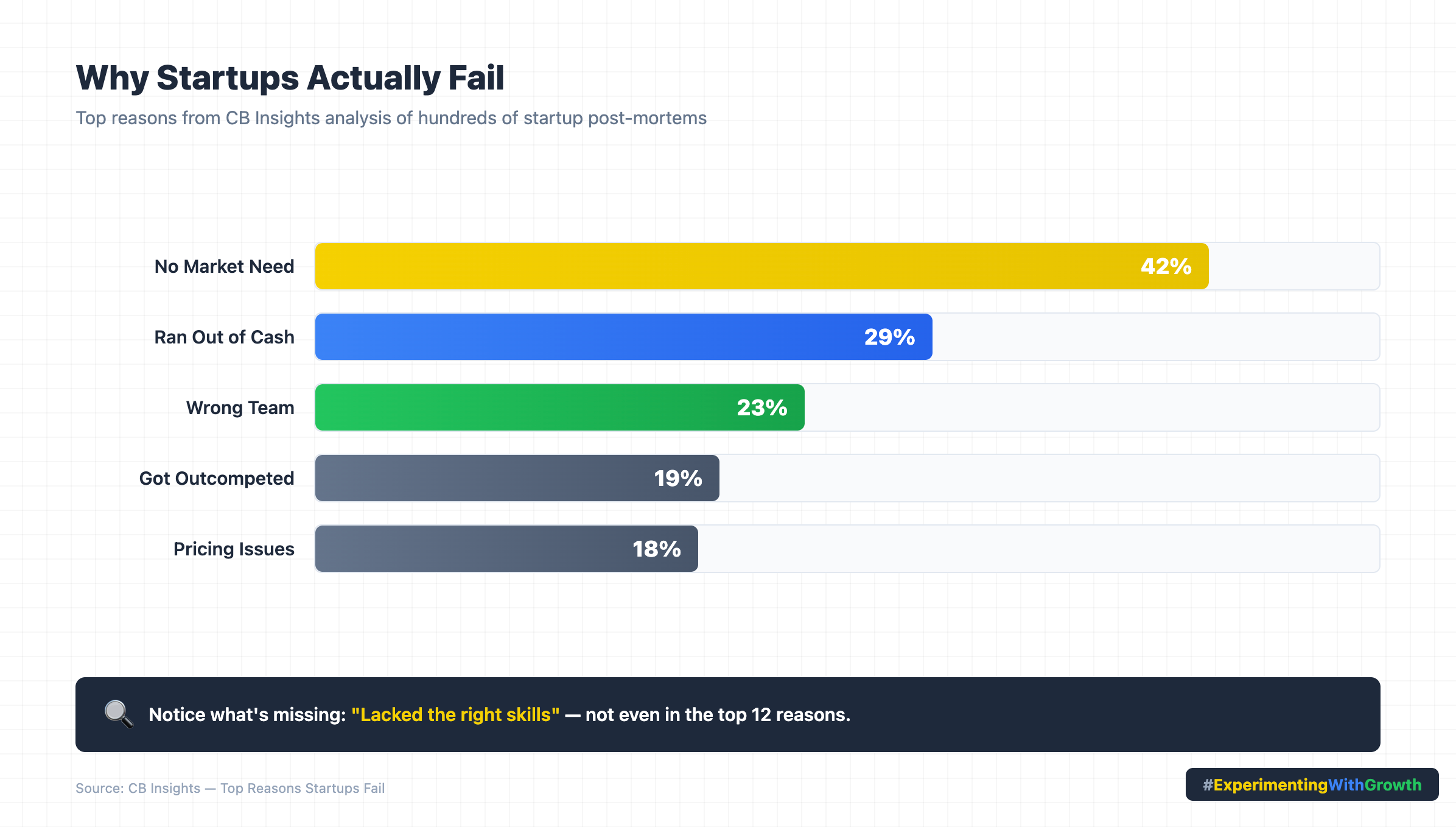
Meanwhile, look at what actually kills startups. CB Insights analyzed hundreds of post-mortems: 42% failed from no market need. 29% ran out of cash. 23% had the wrong team. You know what’s not on that list? “Founders didn’t know enough.”
Skills have a half-life. Grit doesn’t. In the AI era, mindset is the only non-depreciating asset you own. Everything else is a rental.
TL;DR
The claim: In a world where AI can replicate most skills in seconds, the only durable competitive advantage is the mindset to execute relentlessly.
What you’ll walk away with:
Why the “skillset obsession” is a trap, especially now
The four mindset traits that actually compound over time (backed by research)
Five things you can do this week to shift from learning mode to execution mode
Why the Skillset Obsession Is Dying
AI just commoditized your expertise
Claude can code. GPT-5 can write strategy docs. Midjourney can design. Sora can edit video. The skills that took you years to accumulate can now be approximated in seconds by someone who’s never done them before.
This isn’t hypothetical. I use Claude every single day. It handles research, first drafts, data analysis, code. Things that would’ve taken a junior hire a week get done in an afternoon. The skill gap between “expert” and “beginner with AI” has collapsed to almost nothing for 80% of knowledge work.
Harvard Business School’s 2026 AI trends report puts it bluntly: organizations need “change fitness” more than technical skills. The ability to adapt matters more than what you already know.
The credential myth
Here’s a stat that sounds like it proves the opposite of my point: 62% of unicorn founders hold post-graduate degrees. Only 4% of college dropouts become successful founders.
But dig deeper. Those founders didn’t succeed because of their degrees. They succeeded because they had the grit to build something in a market that kills 90% of startups. The degree is correlated with success. The grit is causal.
Steve Jobs, Bill Gates, Mark Zuckerberg, Alex Mashrabov (Higgsfield, $300M ARR in 11 months). The dropouts who made it didn’t have better skills than their peers. They had an unreasonable willingness to keep going when things were broken.
Startups don’t die from ignorance
Go back to that CB Insights data. “No market need” is a judgment problem, not a skill problem. “Ran out of cash” is a persistence problem. “Wrong team” is a people problem. Every single top failure reason traces back to a mindset failure, not a knowledge gap.
Nobody ever built a great company and then lost it because they didn’t know JavaScript. But plenty of people with perfect skills never built anything at all because they were afraid to start, afraid to fail, or too comfortable to grind through the ugly middle.
The 20-hour truth
Josh Kaufman’s research on skill acquisition found that you can learn the basics of any new skill in roughly 20 hours of deliberate practice. The famous “10,000-hour rule” is about world-class mastery. Competence is fast. Commitment is rare.
You don’t need six months to learn enough to start. You need 20 focused hours and the guts to ship something ugly.
The Mindset Stack: Four Traits That Compound
Skills depreciate. These don’t.
1. Grit: sustained effort toward long-term goals
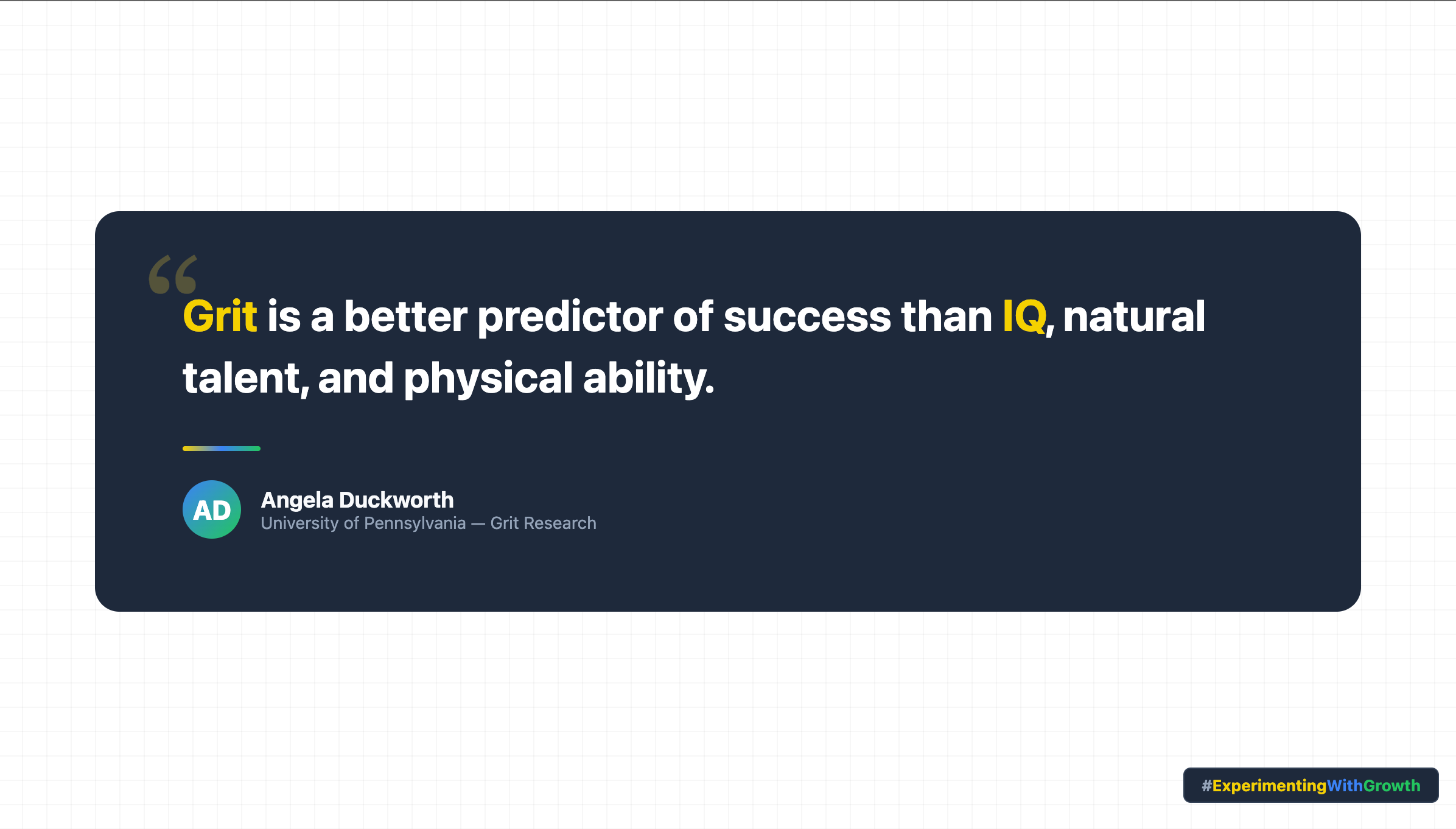
Angela Duckworth’s research at the University of Pennsylvania found that grit is a better predictor of success than IQ, natural talent, and physical ability. At West Point, grit predicted which cadets would survive the brutal “Beast Barracks” summer better than SAT scores, class rank, or physical fitness tests.
Grittier kids in the National Spelling Bee studied longer and advanced further than more naturally talented competitors. The pattern held across every domain Duckworth tested.
The implication for builders: the person who shows up on day 300 beats the genius who quits on day 30. Every time.
Look at David Holz and Midjourney. No VC funding. No marketing team. No sales org. Just relentless product obsession for years until the market caught up. $500M ARR. That’s grit compounding.
2. Discipline: doing the work when motivation disappears
Motivation is a feeling. It shows up on Monday morning after a good weekend and disappears by Wednesday afternoon when nothing’s working.
Discipline is a system. It’s the gym at 6 AM when it’s cold. The cold email #500 when #499 got ignored. The blog post published on schedule even when you have nothing clever to say. The feature shipped at 80% because done beats perfect.
The discipline gap is massive in practice. Most people wait for inspiration. Builders build on schedule. The output difference over a year is staggering.
Higgsfield shipped 4-7 feature releases per week. Not because every release was inspired. Because the system demanded it. That shipping discipline, more than any individual feature, is what drove $300M ARR.
3. Adaptability: learning speed over knowledge depth
The AI era rewards adaptability above all else. The person who can pick up a new tool over a weekend and ship something functional beats the person with five years of experience in the old tool. Every time.
Skills have a shelf life now. The specific framework you mastered? It has a replacement coming. The marketing channel you perfected? It’s getting saturated. The competitive advantage isn’t knowing more. It’s learning faster.
This is the meta-skill behind all skills: the ability to get competent at something new, fast, without needing permission or a curriculum. It’s a mindset, not a skillset. You either believe you can figure it out, or you wait for someone to teach you. The first group ships. The second group upskills.
4. Bias toward action: executing before you’re ready
Most people are in permanent preparation mode. One more course. One more book. One more certification. One more “I’ll start when I know enough.”
You will never know enough. The information you need is on the other side of action, not preparation. You learn what the market wants by launching, not by researching. You learn what works by testing, not by planning. You learn what you’re capable of by doing the hard thing, not by thinking about the hard thing.
I’ve seen this pattern across every growth role and side project I’ve worked on. The people who win aren’t the smartest in the room. They’re the ones still in the room at midnight when everyone else went home. They started before they had the perfect plan. They shipped before the product was ready. They sent the email before they had the perfect pitch.
I wrote about this in “The Upside of Naivete”: sometimes not knowing is the advantage. You don’t know enough to be scared. You don’t know enough to overthink. You just do the thing.

Personal POV: What AI Made Obvious
I use AI every single day. Claude is my co-pilot for research, writing, analysis, code. It’s genuinely good at all of it.
And that’s exactly what made this obvious to me: the 80% of work that AI handles is the skill-based part. Research. First drafts. Data crunching. Code scaffolding. The stuff that used to be the hard part, the stuff that required years of training, is now table stakes.
The 20% that AI can’t do? That’s all mindset. The judgment to know what’s worth building. The discipline to ship when metrics are flat and nothing feels like it’s working. The grit to send the 50th cold email on a Tuesday afternoon when you’d rather be doing literally anything else. The willingness to put your name on something imperfect and let the market tell you what’s wrong with it.
AI didn’t make skills irrelevant. It made them insufficient. You still need to know things. But knowing things is now the easy part. The hard part, the part that separates people who build from people who plan to build, was always mindset. AI just made it impossible to ignore.
Five Things You Can Do This Week
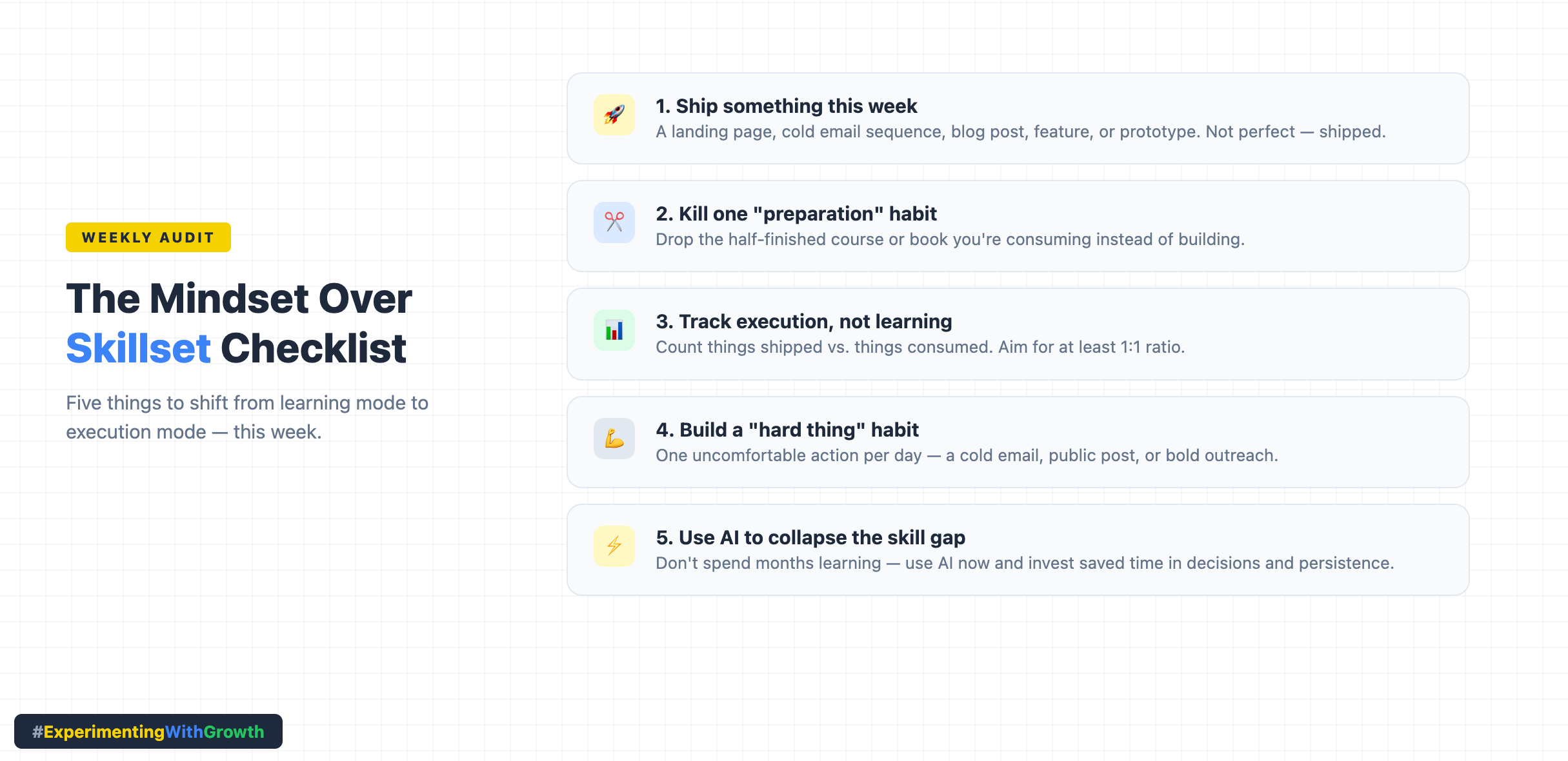
Stop reading about execution. Start executing. Here’s the checklist:
1. Ship something this week. Not next month. This week. A landing page, a cold email sequence, a blog post, a feature, a prototype. Not perfect. Not polished. Shipped.
2. Kill one “preparation” habit. That online course you’re halfway through instead of building? Drop it. That book about entrepreneurship you’re reading instead of doing entrepreneurship? Close it. Go build.
3. Track your execution, not your learning. For one week, count the things you shipped, not the things you consumed. If the ratio is less than 1:1, you’re in preparation mode, not execution mode.
4. Build a “hard thing” habit. One uncomfortable thing per day. A cold email. A cold call. A public post where you share an opinion. A message to someone way above your level. The muscle that matters is the one that lets you do things that feel hard.
5. Use AI to collapse the skill gap. Don’t spend six months learning design. Use AI and ship the design today. Don’t spend three months learning data analysis. Ask Claude and have the analysis by lunch. Spend the time you saved on the work that actually requires you: decisions, relationships, persistence, and taste.
The Bottom Line
Skills depreciate. Grit compounds. In an era where AI can learn almost anything in seconds, the only thing it can’t replicate is the willingness to keep going when it’s hard, boring, and uncertain.
My prediction: in five years, the most successful people in tech won’t be the most skilled. They’ll be the most relentless. The ones who treated every obstacle as a puzzle, not a wall. The ones who shipped 100 things while everyone else was still taking courses about shipping.
What’s the hard thing you’ve been avoiding? Close this tab and go do it.
Subscribe to productgrowth.blog for weekly growth teardowns and no-BS strategy.
FAQs
Why is mindset more important than skillset in the AI era?
AI tools like Claude and GPT can now replicate 80% of skill-based knowledge work — research, writing, coding, and analysis — in seconds. The remaining 20% that drives results is judgment, persistence, and the willingness to execute when things are uncertain. Skills are now table stakes; mindset is the differentiator.
What is grit and why does it predict success better than IQ?
Grit, as defined by researcher Angela Duckworth at the University of Pennsylvania, is sustained effort toward long-term goals. Her studies found that grit outperforms IQ, natural talent, and physical ability in predicting success across domains including West Point cadets, spelling bee competitors, and professional careers.
What are the top reasons startups fail according to CB Insights?
CB Insights analyzed hundreds of startup post-mortems and found the top reasons are no market need (42%), running out of cash (29%), wrong team (23%), getting outcompeted (19%), and pricing issues (18%). Notably, “lacking the right skills” does not appear in the top 12 reasons — every top failure traces back to mindset, not knowledge gaps.
How can I shift from learning mode to execution mode?
Start by shipping something this week — a landing page, blog post, or prototype. Kill one preparation habit like an unfinished course. Track what you ship versus what you consume. Build a daily habit of doing one uncomfortable thing. Use AI to handle skill-based work so you can focus on decisions, relationships, and persistence.
How long does it take to learn a new skill well enough to start?
According to Josh Kaufman’s research on skill acquisition, you can reach basic competence in any new skill with roughly 20 hours of deliberate practice. The famous 10,000-hour rule applies to world-class mastery, not functional competence. You don’t need months of preparation — you need 20 focused hours and the willingness to ship something imperfect.
Is having a degree still important for startup success?
While 62% of unicorn founders hold post-graduate degrees, correlation isn’t causation. Those founders succeeded because they had the grit to build in a market that kills 90% of startups, not because of credentials alone. Successful dropouts like Steve Jobs and Mark Zuckerberg shared an unreasonable willingness to persist through failure — proving mindset matters more than credentials.