

The Upside of Naivete
George Dantzig solved "unsolvable" problems because he thought they were homework. The same principle builds empires.

The Homework That Changed Mathematics
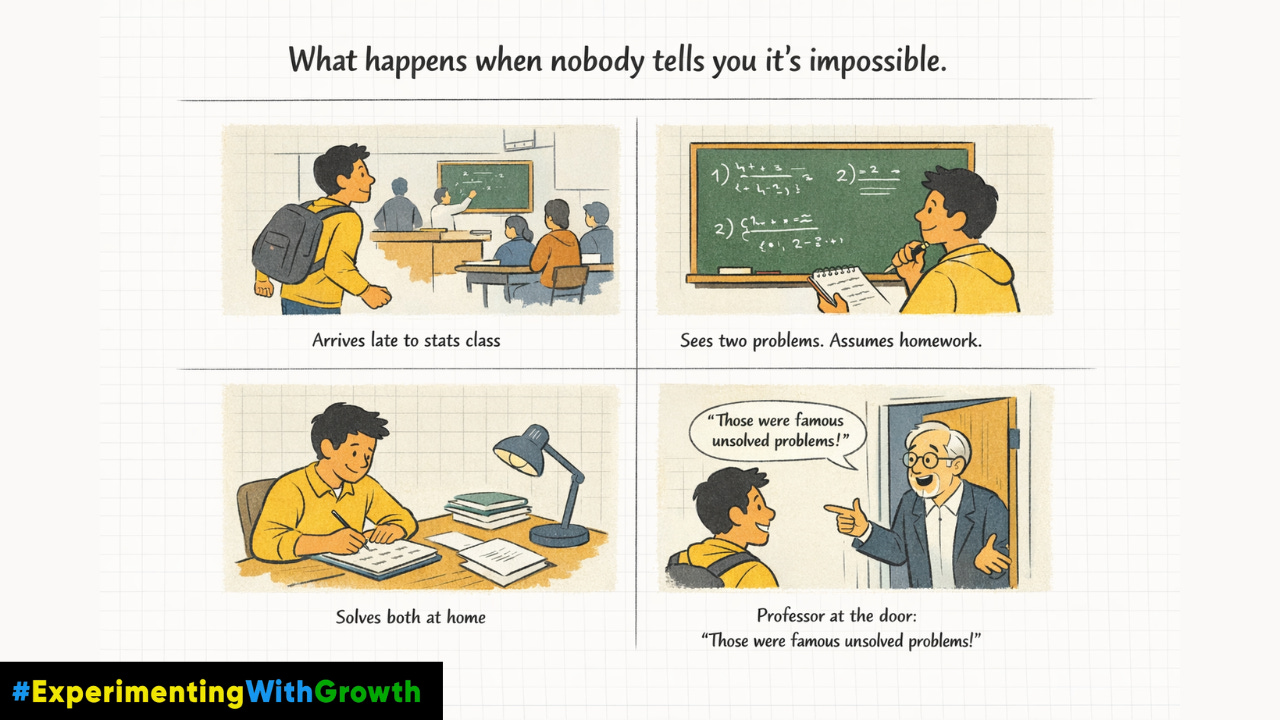
In 1939, a PhD student named George Dantzig walked into his statistics class at UC Berkeley. He was late.
Two problems were written on the board. He assumed they were homework. He copied them down, went home, and solved them.
A few weeks later, his professor, Jerzy Neyman, knocked on his door in disbelief. Those weren’t homework problems. They were two of the most famous unsolved problems in statistical theory.
Dantzig solved them because nobody told him they were unsolvable.
This story gets shared as an inspirational anecdote. But there’s a deeper truth buried in it that applies directly to how we build companies, hire people, and set goals.
Naivety, when paired with optimism and skill, is one of the most underrated advantages in business.
Why Experience Installs a Ceiling
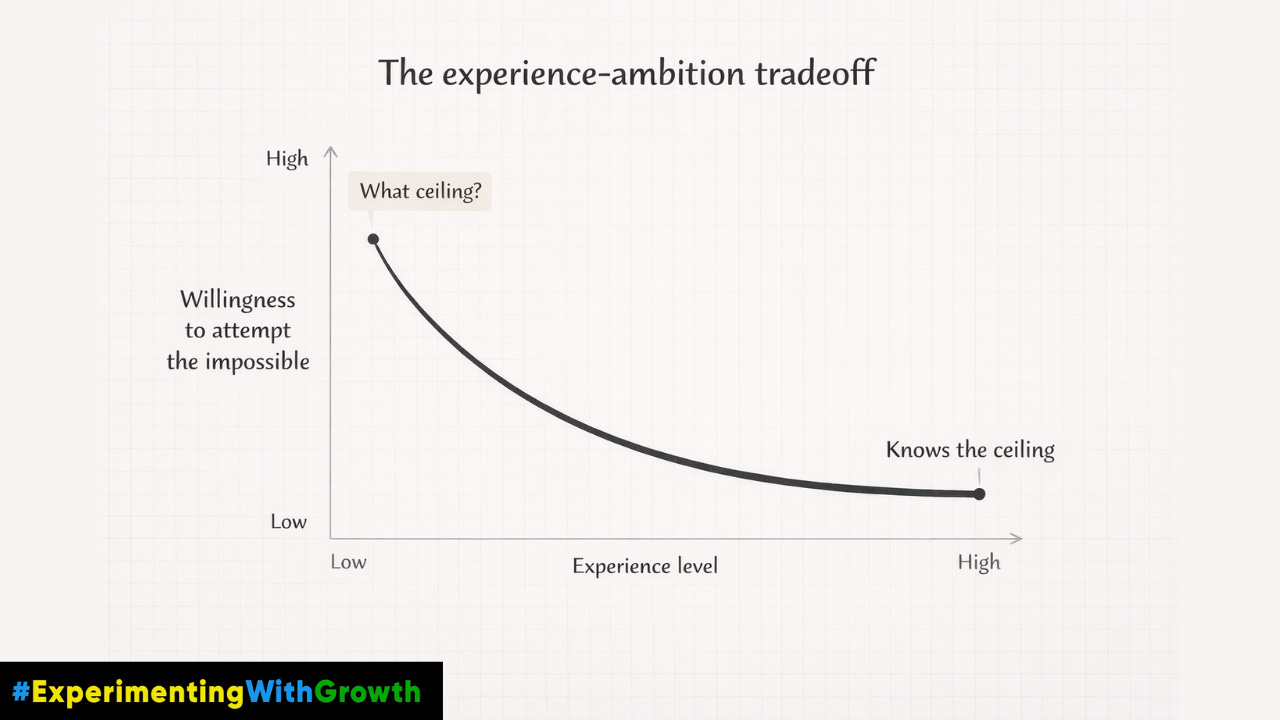
Experience teaches you what works. But it also teaches you what “can’t” work.
The more time you spend in an industry, the more pattern-matching your brain does. You’ve seen what failed before. You know which channels are “saturated.” You know which growth rates are “realistic.” You know the benchmarks.
All of that knowledge creates an invisible ceiling.
An experienced growth marketer might look at a new B2B SaaS product and say, “With this budget, in this niche, we should target 50-100 signups in the first month. That’s a solid start.” They’re probably right. That IS a reasonable target based on historical data.
But “reasonable” is a cage when you don’t realize you’re inside it.
Here’s where I want to be honest. A 2018 NBER study published in the American Economic Review found that the mean age of founders behind the top 0.1% fastest-growing ventures in the US is 45 years old. Prior industry experience predicted significantly higher rates of entrepreneurial success.
On average, experience wins. The data is clear.
But averages tell you about the middle of the distribution. They don’t tell you about the tails. And the tails are where world-changing companies get built.
The Naive Founders Who Built Empires
Let’s look at people who didn’t know what was impossible.
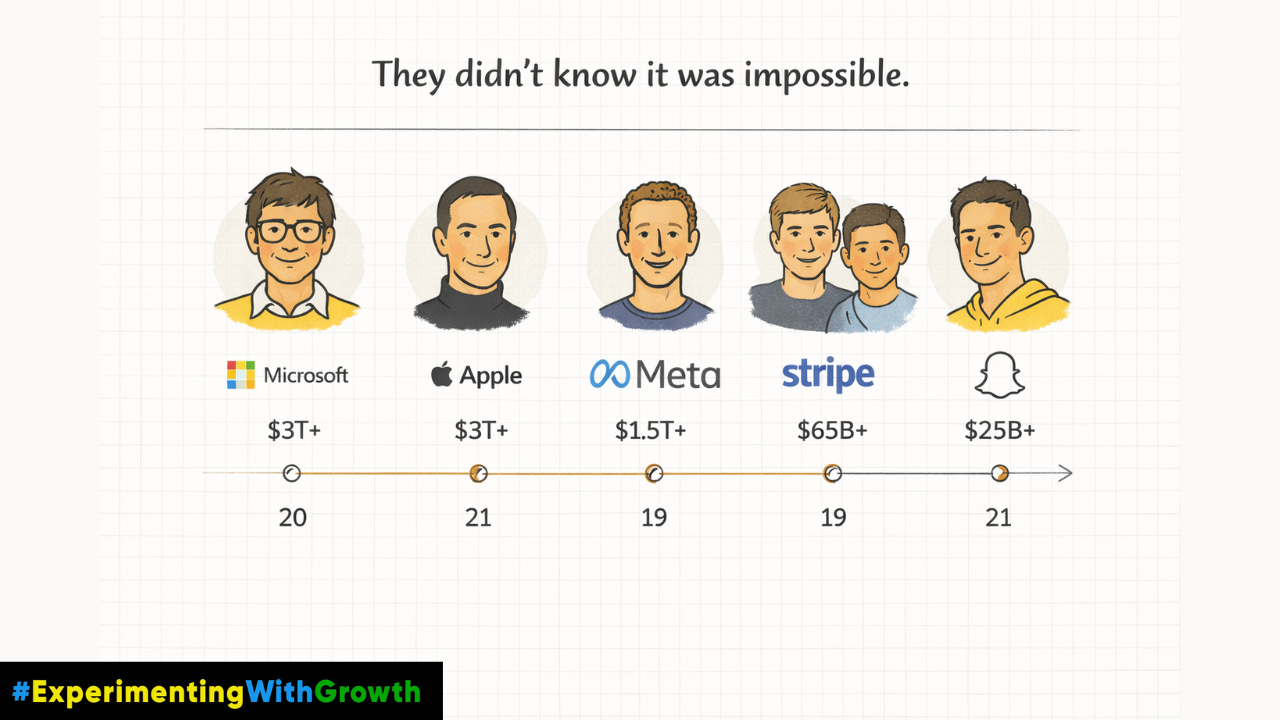
Bill Gates dropped out of Harvard at 20 to start Microsoft. The personal computer industry barely existed. There were no rules to follow because there was no established playbook.
Steve Jobs co-founded Apple at 21 with no engineering degree. He designed products based on intuition and taste, not market research. When the entire tech industry built for engineers, he built for humans. That felt naive at the time.
Mark Zuckerberg launched Facebook from his dorm room at 19. A year later, Yahoo offered $1 billion to buy it. He turned it down. Every experienced advisor told him he was insane. Today, Meta is worth over $1.5 trillion.
A seasoned executive would have taken the billion. Zuckerberg didn’t know you’re “supposed to” take the exit.
Patrick and John Collison started Stripe at 19 and 21. Two Irish teenagers decided to fix online payments, a problem massive banks had struggled with for years. No fintech experience. No regulatory expertise. They just thought existing solutions were bad and started building. Stripe is now valued at over $65 billion.
Evan Spiegel launched Snapchat at 21. Disappearing messages. Every experienced person in Silicon Valley called it a toy. Today, Snap has over 850 million monthly active users.
The pattern:
“None of them had enough experience to know the rules of their industry. Because they didn’t know the rules, they didn’t play by them.”
The Flip Side: Naive Pessimism is Poison
Before you go hiring every bright-eyed graduate you can find, there’s a critical nuance.
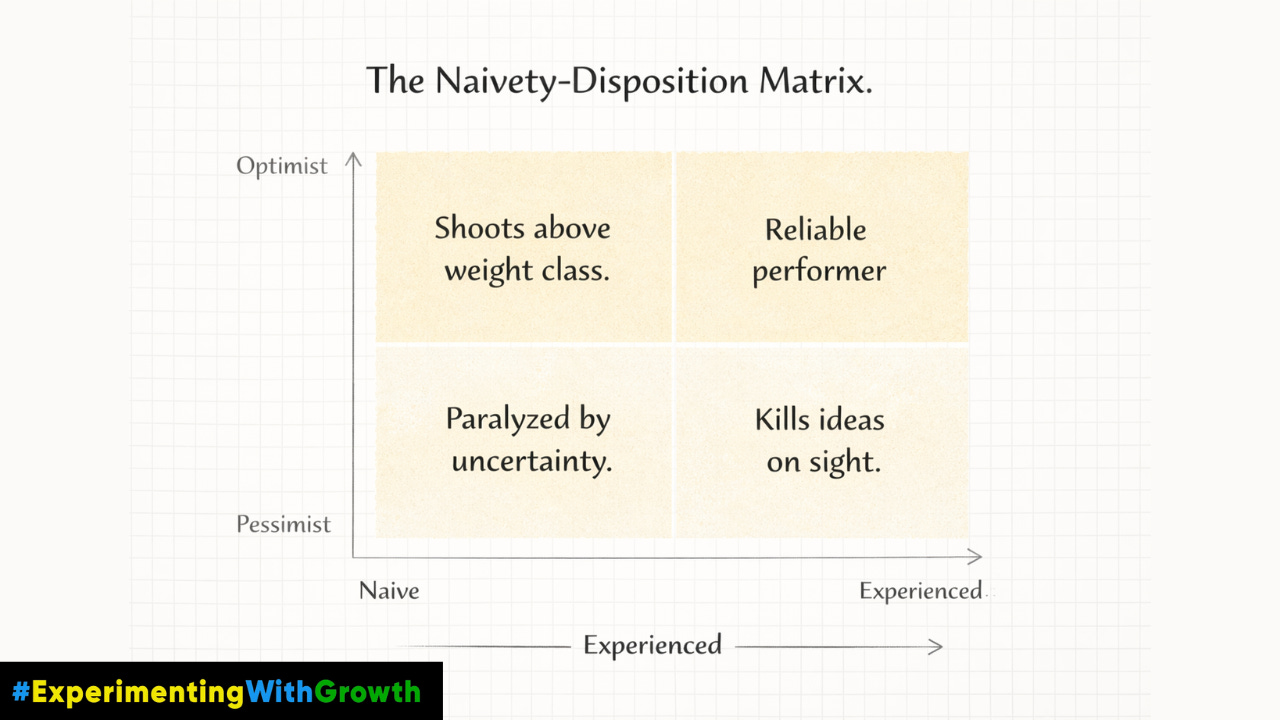
Naivety by itself is neutral. What determines whether it becomes a superpower or a liability is the person’s disposition.
Two people who’ve never run a marketing campaign before:
Person A (Naive Optimist): “I’ve never done this before, but how hard can it be? Let me figure it out.”
Person B (Naive Pessimist): “I’ve never done this before. What if I waste the budget? Maybe we should start smaller.”
Same experience level. Same skill. Completely different outcomes.
The naive optimist swings above their weight class. They set ambitious targets because they genuinely don’t know those targets are “unrealistic.” And sometimes, because they aim so high, they hit things veterans never even attempt.
The naive pessimist thinks small. They hedge. Every setback feels like proof they were right to be cautious.
“Naivety is the amplifier. Optimism or pessimism is the signal it amplifies.”
What I Learned at ngram
I’ll share something from my own experience.
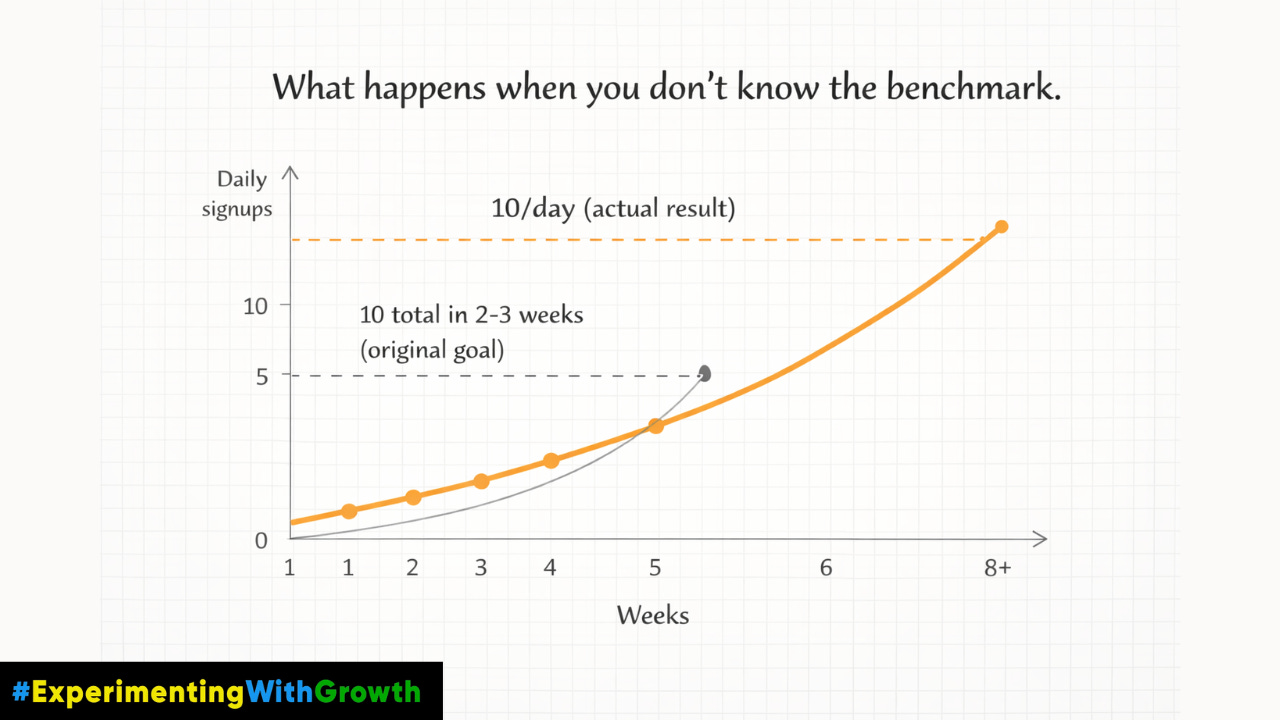
When I joined ngram.com as growth lead, I set a target: 10 signups within 2-3 weeks of building the basic growth foundation.
I had no idea if that was realistic. Didn’t benchmark it against industry standards. Didn’t look up “average signup rates for AI video platforms.” I picked a number that felt like a meaningful proof point and went after it.
Here’s what I deliberately didn’t do: research whether my target was achievable. Because if I had, I probably would’ve found some benchmark telling me to expect 2-3 signups per week in the early days. And I would have optimized for that instead.
The result? We’re now getting 10 signups every single day.
Was the original target naive? Absolutely. But because I didn’t know the “normal” baseline, I didn’t anchor to it. I aimed higher than an experienced growth lead with 10 years in B2B SaaS would have. And it worked.
Not knowing the ceiling meant I never stopped climbing.
How to Use Naivety as a Strategy
Four things you can apply this week:
1. Hire for skill + optimism, not just experience.
Ask candidates about times they attempted something without knowing if it was possible. Listen for how they talk about uncertainty. “I wasn’t sure it would work, so I was cautious” vs. “I had no idea if it would work, so I just tried it.” That response tells you more than their resume.
2. Set targets before researching benchmarks.
Decide what success looks like BEFORE you look up what’s “normal.” Benchmarks are useful as a sanity check after the fact. As a starting point, they anchor you to mediocrity.
3. Don’t over-validate creative ideas.
Some things only work because nobody told you they wouldn’t. If Snapchat had been validated through market research with experienced social media executives in 2011, it would have died in the concept phase. Validation has its place. Don’t let it become a filter that kills your best ideas before they breathe.
4. Remember the guardrail: naivety without skill is just ignorance.
This entire thesis has one dependency. The person needs raw capability to execute. Dantzig was a brilliant mathematician who didn’t know those specific problems were considered unsolvable. Gates could code. Jobs had taste and vision. Zuckerberg was a gifted programmer. The naivety was about context, not competence. Naive AND unskilled doesn’t give you breakthroughs. It gives you chaos.
Where This Is Heading
As AI makes “experience-based knowledge” accessible to everyone, the premium on naive optimism will only grow.
Think about it:
if anyone can access best practices, playbooks, and benchmarks in 30 seconds, knowing the playbook stops being a competitive advantage.
The advantage shifts to people willing to ignore it. The ones who don’t know what’s “supposed to” work and try something different.
George Dantzig solved unsolvable problems because he didn’t know they were unsolvable. The biggest breakthroughs have always come from people who didn’t know the rules.
That’s not going to change. If anything, it’s about to matter more than ever.
What’s the most naive thing you’ve ever attempted that actually worked? I’d love to hear your stories. Drop them in the comments or find me on LinkedIn.